Storytelling: Humanity's Ancient Itch to Tell Stories

Updated: Sep 12
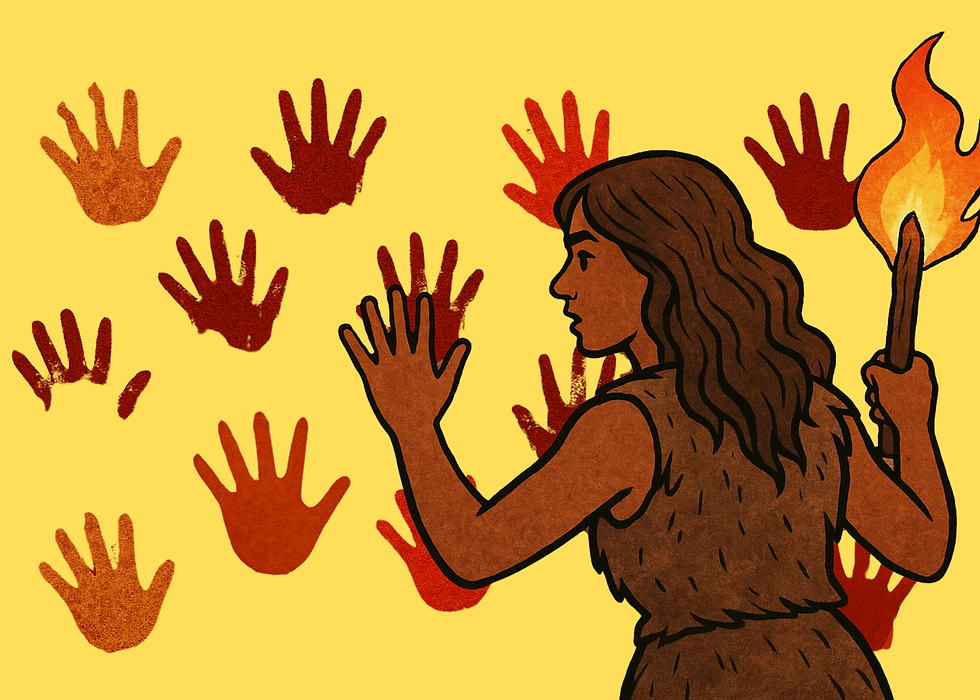
Humans have always had an rrge to leave a mark. Do you remember being a child and carving your name into the bark of a tree with a pocketknife? Or taking a stick and drawing a huge heart in the sand with something like “A+Z” inside it, or other letter combinations? That's just mine and my husbands. Or scribbling your initials across the corner of your school desk in bold, bubble letters?
Maybe you left a secret mark on a wall or created doodles that only you understood. Humans have always had this itch to say, I was here. From cave walls to MacBook stickers, we have never stopped leaving traces of ourselves.
Echoes From The Past
The instinct is ancient. Our Homo sapiens ancestors left handprints on cave walls tens of thousands of years ago. Bu these were more than just mere marks. They were proof of existence, whispers through time, telling us (or maybe telling themselves), that this is my story. This is our story. Centuries later, we’re not so different from our ancestors.
The questions we ask today are existential. Why did they do it? Was it for the future? For themselves? Or simply to make sense of their world? Whatever the reason, those cave paintings continue to spark curiosity and connect us to them. They remind us that storytelling is not just art, it’s survival. It’s how we understand ourselves, each other, and the world around us. And we want to do it,tell stories that is. We want to be remembered in some shape or form before we're gone. And storytelling, it seems, is the timeless habit of creating our remembrance.
The Modern Storyteller
Today, we tell stories through books, films, social media posts, songs, art, and podcasts. The tools have changed, but the itch remains. The question now is: how will this tradition evolve in the age of AI?
When Technology Becomes The Antagonist
AI is fast, efficient, and capable of weaving words in ways that surprise us, even scare us. But here’s the tension: will this efficiency erase individuality? If AI can write better, quicker, and sharper than we can, what happens to the human voice—the messy, imperfect, emotional voice that makes our stories unforgettable?
Imagine if those cave paintings we marvel at today were not created by human hands, made of flesh and blood but by some cold steel alien technology. Would they still move us? Would they carry the same weight? Probably not. Because what makes stories powerful is not their perfection nor the nano-tech software they're written with, but their humanity.
The Discipline Of Storytelling
Storytelling is like exercise. It builds strength slowly, through practice, discipline, and guidance. It’s not always easy. But when you do it, you participate in a tradition as old as fire and as essential as breath.
Your Turn To Tell The Story
This is where you, the modern human, step in. You are the writer of your story. You're also the hero of your story, or maybe sometimes the villain. Some say the real antagonist is technology, in all its tempting efficiency, and that's a tempting excuse we make. I don't think technology has to be the antagonist, and we don't have to be so hyper-focused on all the predicaments it brings. We can always focus on the protagonists, our guides. And your guide? Teachers, coaches, and everyone who believes in the enduring magic of writing.
Why Storytelling Still Matters
Stories make the world go round. They build communities, spark revolutions, preserve love, and challenge power. Long after we're gone, the stories we leave behind—printed in books, held in memory, or whispered through generations—will remain. They may not change the world. But then again, they might.
So keep telling them, whether you’re opening a neighbourhood café, building an app from scratch, or turning an idea scribbled in the margins of a notebook into a brand. Storytelling isn’t simply something humans do, it's how we make sense of ourselves, find one another, and give people a reason to care.
Your Brand Has a Story. Tell It Like You Mean It.
The internet doesn’t need another brand listing its services like the ingredients on the side of a cereal box. It needs the café that began as a jumble of names and ad ideas scribbled by its future CEO across a coffee-stained napkin.
Leave the AI slop with Chat. Get real marketing copy written by humans who care about words, stories, and the people reading them, a little too much.


Comments